

Estate Planning Strategies Non-Biological Parents Must Know

A blended family walking on the beach after they completed estate planning for non-traditional families

In today’s diverse society, the concept of family extends far beyond traditional biological ties. Non-biological parents, including stepparents, LGBTQ+ parents, and adoptive parents, play a vital role in nurturing and raising children.

However, your families often face unique legal challenges that can jeopardize your parent-child relationship.

Estate planning for blended families safeguards your rights and ensures your children are protected, both emotionally and financially. Without proper planning, non-biological parents may encounter obstacles in making critical decisions, inheriting assets, or even maintaining custody of your children.

Blended families are becoming more of the norm. For example, according to data from Pew Research Center, approximately 16% of children under 18 in the United States live in blended families with a biological parent and a stepparent.

While these diverse family structures are increasingly common, the legal landscape has not always kept pace. This article delves into the complexities faced by non-traditional families and provides strategies to navigate the legal landscape, ensuring your parent-child bond is protected.

Legal Status of Non-Biological Parents

The bond between a non-biological parent and their child is a sacred one, nurtured through countless moments of love, guidance, and unwavering commitment. However, the legal system often fails to automatically recognize and protect these cherished relationships.

In many states, non-biological parents may lack inherent legal rights over their children, leaving them vulnerable in situations that could tear families apart, such as custody battles, inheritance disputes, and even medical emergencies.

Imagine the heartbreak of being denied the ability to make critical healthcare decisions for your child or losing custody and visitation rights simply because the law does not recognize the depth of your parental bond.

For a non-biological parent who has lovingly raised their spouse’s child from infancy, the thought of being legally barred from inheriting or providing for that child without explicit documentation is a devastating prospect.
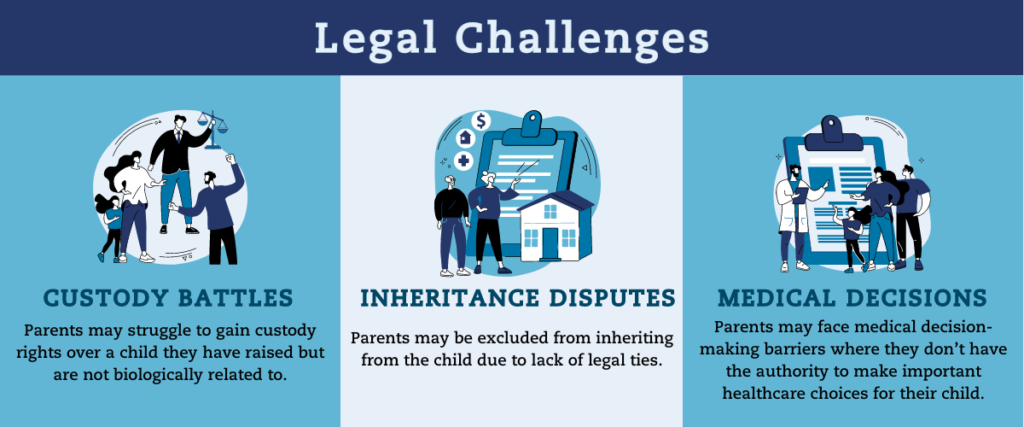
Legal challenges faced by non-biological parents

Karen’s Story

Karen went through a lengthy and painful legal battle to be recognized as the legal parent of her two children,  despite being their non-biological parent. Karen and her former partner Julie had the children through assisted reproductive technology while living in Florida. Karen was present for their births and took on all parental duties as a second mom.

However, when the couple later separated after moving to Massachusetts, Julie refused to allow Karen to adopt the children. Karen had to file legal complaints seeking to be declared a “de facto” parent and then a legal parent. After an agonizing three-year court battle, Karen finally won the right to legally parent her children.

Karen’s story highlights the challenges non-biological parents can face in being recognized legally, even when they have raised the children from birth. The years of uncertainty took an emotional toll on Karen and her children, not to mention the significant legal fees.

As Karen states, “Children shouldn’t suffer any uncertainty at all about who their parents are.” Her case underscores the need for laws that enshrine equality and security for all families.

Karen’s heartbreaking story serves as a poignant reminder of the challenges non-biological parents can face in being legally recognized as parents, even when they have nurtured and loved their children from birth.

The years of uncertainty and emotional turmoil she endured underscore the urgent need for proactive measures to safeguard the sacred bond between non-biological parents and their children.

While the legal landscape can be complex, there are estate planning strategies that can provide a robust framework for protecting your family’s future. By taking proactive steps, you can solidify your parental rights and responsibilities, ensuring that your cherished bonds and values are safeguarded for generations to come.

Estate Planning Strategies for Non-Biological Parents

Research done by Hugh Magill, Former Vice Chairman at Northern Trust, shows how family structures have evolved and how this complexity has led to lack of planning for those families.
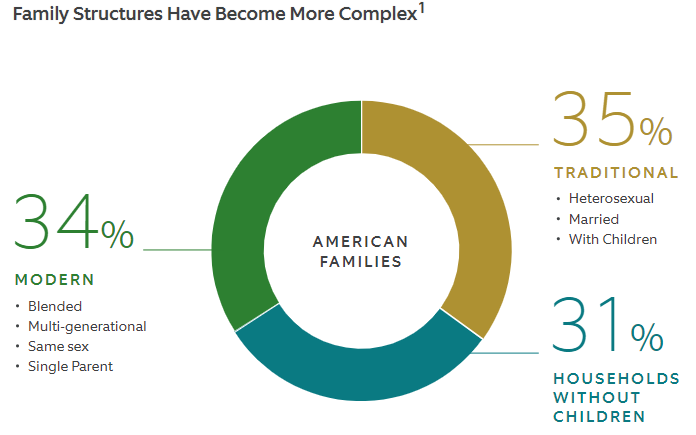
Circle chart - Family Structures Have Become More Complex - The Northern Trust Institute

Wills and Trusts

One of the most powerful tools in a non-biological parent’s estate planning arsenal is the creation of wills and trusts. Through a carefully crafted will, non-biological parents can nominate a guardian to care for their minor children in the event of their incapacity or death.

This crucial step ensures that the children are placed in the custody of a trusted individual who shares the parents’ values and can provide a loving, stable environment.

Additionally, wills allow non-biological parents to provide for their children financially by designating them as beneficiaries of their assets and inheritance. Trusts can further bolster this financial security by establishing a structured mechanism for managing and distributing assets for the children’s benefit. benefit.

While wills and trusts are essential components, a comprehensive estate plan often requires additional legal documents to fully protect your family’s interests.

Other Legal Documents

In addition to wills and trusts, non-biological parents should consider executing other legal documents to reinforce their parental rights and responsibilities. A power of attorney can grant a designated individual the authority to make legal decisions on behalf of the children, ensuring their affairs are properly managed.

Similarly, a healthcare proxy empowers a trusted person to make medical decisions for the children if the parents are incapacitated or unavailable. These documents provide an additional layer of protection, ensuring the children’s well-being is never compromised.
The 5 Legal Documents Every Parent Must Have

Secure Your future with a plan

Additional Considerations

Comprehensive estate planning for non-biological parents extends beyond just legal documents.

It’s crucial to review and update beneficiary designations on life insurance policies, retirement accounts, and other assets to ensure that children are properly provided for. Re-titling assets as joint or community property can also help solidify the children’s claims to inheritance and avoid potential disputes.

Non-traditional family situations may require additional planning considerations. For example, providing clear instructions for roles and responsibilities of multiple parental figures, such as step-parents, donors, or surrogates, can help mitigate future conflicts.

Likewise, addressing the unique dynamics of blended families or LGBTQ+ relationships (add link to LGBTQ+ article) can ensure that the estate plan accurately reflects the family’s wishes and protects the interests of all involved parties.

By taking a holistic approach and addressing these additional factors, non-biological parents can create a comprehensive estate plan that leaves no stone unturned, safeguarding their children’s futures and preserving the integrity of their family unit.

The Emotional Aspect

While estate planning for non-biological parents is primarily a legal endeavor, it also carries profound emotional significance.

By formalizing the parent-child bond through legally binding documentation, non-biological parents can solidify their commitment to their children and ensure that their wishes for their care and upbringing are respected.

This process not only provides peace of mind but also serves as a tangible expression of love and devotion.

Comprehensive estate planning can help avoid potential family conflicts or legal battles that could strain relationships and cause emotional turmoil for the children.

By clearly outlining their desires and establishing a framework for decision-making, non-biological parents can minimize the risk of disputes and ensure that their children are cared for according to their values and principles

Working with an Attorney

While estate planning for non-biological parents can be a complex and emotionally charged process, seeking professional legal guidance is essential. An experienced estate planning attorney can navigate the intricate web of laws and regulations, ensuring that all necessary documents are properly executed and tailored to the specific needs of the family.

When selecting an attorney, it is crucial to prioritize experience and expertise in handling non-traditional family structures.

An attorney well-versed in the nuances of estate planning for non-biological parents can provide invaluable insights and strategies specific to the family’s unique circumstances. This personalized approach is vital, as no two families are alike, and a one-size-fits-all solution may fail to protect your family.
10 Things to Ask Before Hiring an Estate Planning Lawyer

10 Things to ask before hiring an estate planning attonrey

Safeguard Your Family's Legacy Today

For non-biological parents, the journey of creating and nurturing a family is often filled with unique challenges and complexities. However, by embracing comprehensive estate planning, you can navigate this legal landscape with confidence, ensuring your cherished bonds and values are safeguarded for generations to come.

The strategies we discussed, including wills, trusts, and powers of attorney, provide a robust framework for solidifying your parental rights and responsibilities. By taking proactive steps, you can secure your children’s futures, both emotionally and financially, and mitigate the risk of potential conflicts or legal battles that could strain family relationships.

Estate planning for non-biological parents transcends mere legal formalities. It represents a profound act of love and commitment, formalizing the unbreakable bond between parent and child and ensuring that your family’s wishes are respected, even in the face of life’s uncertainties.

Do not let uncertainty or legal complexities jeopardize the legacy you have built for your family. Take the first step today by scheduling a consultation with our experienced estate planning attorneys, who specialize in non-traditional family dynamics.

Together, we will craft a customized plan that accounts for your unique goals, values, and legal considerations, leaving no stone unturned in protecting your family’s future.

By working with our dedicated team, you can rest assured that the love, sacrifice, and life lessons you have poured into your family will endure, shielded from the uncertainties of tomorrow.

Your family deserves nothing less than the utmost protection and peace of mind that a well-crafted estate plan can provide. Take the first step today and secure your family’s legacy for years to come.

As a parent, you may have questions about what you really need in place to protect your kids, your family, your assets, and yourself. From guardians and trusts to wills and health care documents, it can be hard to know where to start. Read on for answers to some of the most common estate planning questions we hear from parents.

Question 1: What is an estate plan?

When people hear the word estate, they often imagine mansions or large investments, but your estate is simply everything you own: your home, savings, personal belongings, and, most importantly, the people you want to protect.

Estate planning is about making thoughtful decisions ahead of time. It allows you to decide who would care for your children, who would make financial or medical decisions if you couldn’t, and how you want your assets managed and distributed.

Whether you’re just starting your career, growing your family, or planning for retirement, an estate plan gives you the opportunity to make those decisions yourself rather than leaving them to default state laws.

Question 2: Do I really need an estate plan if I’m young and healthy?

Even if you’re young and healthy, estate planning matters because life can change in an instant.

With a plan, you name guardians and decision-makers. Without one, many of those decisions may be left to the court or determined by state law. For example, if both parents are unable to care for their children and no guardian has been named, a court will appoint one.

A thoughtful plan can protect your family’s future, provide guidance, and help ensure your children’s inheritance is handled the way you intend.

Online forms and AI tools can be useful for general education, but they can’t provide legal advice or tailor a plan to your needs. An experienced estate planning attorney can help create a plan that’s customized, complies with state law, and is designed to hold up legally when your family needs it most.

Question 3: What documents are included in an estate plan?

A comprehensive estate plan includes several key documents that work together to protect your family.

A Will lets you name guardians for your minor children and direct how your assets are distributed.

A Revocable Living Trust can help avoid probate and provide more control over how assets are managed and distributed.

A Durable Financial Power of Attorney allows someone you trust to manage your financial affairs if you become incapacitated.

A Health Care Proxy allows you to appoint someone to make medical decisions on your behalf if you’re unable to do so.

A HIPAA Authorization gives the people you choose permission to access your medical information when needed.

The right combination of documents depends on your stage of life and your family’s unique needs.

Question 4: Do I need a will, a trust, or both?

This is one of the most common questions parents ask, and the answer depends on your goals.

A will allows you to name guardians for your minor children and direct how your assets are distributed.

A revocable living trust is often used alongside a will. It can help avoid probate, provide privacy, and give you more flexibility in how assets are managed and distributed.

For parents of young children, one of the biggest advantages of a trust is the control it provides. A trust lets you decide when and how your children receive their inheritance rather than having assets become available when they reach legal adulthood. Without that structure, significant assets like a home or investments may become available at a much younger age than most parents feel is wise. A trust also allows you to appoint someone you trust to manage those assets until your children reach the ages or milestones you choose.

For many families, the right solution includes both a will and a trust. It depends on factors like home ownership, the age of your children, and whether you want to avoid probate or set conditions for an inheritance.

Often, the better question isn’t “Do I need a will or a trust?” but “What do I want my plan to accomplish for my family?”

Question 5: How much does estate planning cost?

The cost of estate planning can vary widely depending on your family’s unique situation, goals, and the complexity of the plan.

The most important question isn’t simply what it costs, but what level of planning will best protect your family.

Once an attorney understands your goals and your situation, they can recommend the right approach and explain the fees up front.

Question 6: What happens if I don’t have an estate plan?

There is always a plan. It just may not be the one you would have chosen.

If you don’t create an estate plan, Massachusetts law provides a default plan for many important decisions. Those laws are meant to provide a framework, but they can’t account for your family’s unique needs or your preferences.

Without a plan, a court may need to appoint guardians for your minor children. Assets will be distributed according to state law, and your loved ones may experience unnecessary delays and additional stress.

Creating a plan allows you, not the state, to make those important decisions and provides clear guidance when your family needs it most.

Question 7: How do I choose a guardian for my children?

Choosing a guardian is one of the most important decisions parents make, and it can also be one of the toughest.

Many families struggle to find the one “perfect” person. At our firm, we help parents think through the decision and identify the best fit for their family. We’ll discuss questions you may not have considered, explore different scenarios, and help you make a decision that reflects your values and gives you confidence in your plan.

Thoughtful estate planning also allows you to clearly document your wishes. In some situations, parents have strong feelings about people they do not want serving as guardians. Clearly expressing those preferences in your legal plan can provide important guidance and help reduce uncertainty if difficult decisions ever need to be made.

Remember, naming a guardian isn’t permanent. As your children grow and circumstances change, your plan can be updated to reflect your family’s evolving needs.

Question 8: What happens if I don’t name a guardian?

If both parents are unable to care for their children and no guardian has been named, a court will appoint someone.

The court’s responsibility is to act in the child’s best interests, but without your guidance, the court could appoint someone you would not have chosen.

By naming a guardian, you provide the court with important guidance about who you believe is best suited to raise your children.

Question 9: When should I update my estate plan?

Estate planning isn’t something you do once and forget. Your plan should grow and change as your life does.

It’s a good idea to review your estate plan after major life events, including:

  • Getting married or divorced

  • The birth or adoption of a child

  • When your children become legal adults

  • Buying or selling a home

  • Receiving a significant inheritance

  • Starting or selling a business

  • A significant change in your financial situation

  • The death or incapacity of someone named in your plan, such as a guardian, trustee, executor, or agent under your power of attorney

  • Moving to another state

  • If your child is diagnosed with special needs, or if their diagnosis, abilities, level of independence, or long-term care needs change over time

  • Every three to five years, even if nothing major has changed

At our firm, estate planning is an ongoing relationship, not a one-time transaction. As your family grows and life changes, we’ll help you review and update your plan so it continues to reflect your wishes and protect the people you love.

Question 10: Can I create my estate plan using AI or online forms?

AI tools and online forms can be helpful for learning basic concepts or organizing your thoughts, but they can’t give legal advice or evaluate your family’s unique situation.

An estate plan is more than a set of forms. It’s a coordinated legal strategy designed around your specific goals and family dynamics.

If key issues aren’t addressed, certain decisions may default to state law, which can lead to unintended results.

Working with a qualified estate planning attorney who works with young families every day helps ensure your plan is tailored to your family’s needs and wishes. Rather than a one-time transaction, you’ll have a trusted advisor who can help keep your plan current as life changes.

Question 11: How do I get started?

Getting started is often easier than people expect.

The first step is scheduling a complimentary 15-minute call with our Client Services Coordinator.

You don’t need to have all the answers before you reach out. You don’t need to know exactly who you’d choose as guardians or what documents you need. That’s what we’re here to help with.

During that call, we’ll learn a little about your family, answer your initial questions, explain what to expect, and help determine the next best step.

If it makes sense to move forward, we’ll schedule a planning session with one of our attorneys, where we’ll talk through your goals, explain your options in plain language, and help you feel confident about the path forward.

Our goal is to make estate planning approachable, understandable, and personal so you can move forward with confidence, knowing your family is protected.

Question 12: What can I expect during my planning session?

Your planning session is a conversation, not a presentation.

We’ll take time to get to know you, listen to your goals, and answer your questions. We’ll walk you through decisions you may not have thought about, such as guardianship and how and when assets should pass to your children.

By the end of your planning session, you’ll have a clear understanding of your options, what we recommend, why we recommend it, and what the next steps look like.

Our goal isn’t simply to create legal documents. It’s to help you build a thoughtful estate plan that reflects your wishes and protects the people you love.

Question 13: How long will my estate plan take to complete?

Creating your estate plan begins with your planning session, and we ask clients to reserve about 90 minutes so we can truly understand your family and your goals.

During the first part of your planning session, we’ll get to know you, answer your questions, explore your wishes, and discuss what’s most important to you. We’ll explain your options in plain language and recommend the level of planning that’s right for your family’s unique situation.

If you decide to move forward with our firm, the second part of the planning session is spent beginning to design your estate plan. Together, we’ll map out the important decisions and gather the information needed to prepare documents that reflect your wishes and protect your family.

It takes about four weeks from your planning session to signing your estate planning documents. A lot will depend on how quickly you’re able to finalize your decisions. It’s important to remember that nothing is legal until it is signed, so we move you to your signing meeting as quickly as possible.

We’ll be with you every step of the way, keeping you informed so you’ll always know what to expect.

Ready to protect your family? Schedule a complimentary 15-minute call with our Client Services Coordinator to get started. Let’s chat. 

Parents Estate Planning Logo

The Parents Estate Planning Law Firm, PC

At The Parents Estate Planning Law Firm, we answer your questions at your convenience; we stay in frequent communication; and we meet to discuss changes in life circumstances and in the law to ensure that your assets are protected.

Share This:

Schedule a
Planning Session

Free Monthly Newsletter

Get valuable information delivered to your inbox each month!

Special Reports

Image of Kids Protection Planning Guide

Kids Protection Planning Guide®

Emptying the Nest

Emptying the Nest: 8 Ways Your Estate Plan Changes When Your Children Become Adults